Meta, the Metaverse, and Horizon Worlds: It's still early days
May 21, 2026
There was a time when every large technology company seemed to be talking about the metaverse. Then the hype collapsed, AI took over the conversation, and suddenly the fashionable thing to say became: the metaverse is dead. If I got a dollar every time someone said that, I would probably have more money than Meta has spent on it.
Jokes aside, I think that conclusion is premature. Not because the 2021 version of the hype was correct, but because the actual metaverse, with the capabilities people were imagining, has not really been built yet.
What Is the Metaverse?
If the word metaverse means anything useful, it cannot just mean "a 3D app with avatars." By that definition, a multiplayer game, a VR chat room, or a branded virtual event would all qualify, and the word stops doing any work. A more serious definition needs persistence, shared presence, user identity, digital objects, creator economies, and most importantly, a high degree of interoperability between platforms.
That last part is the one almost everyone skips. Cross-platform capability is the core missing piece. A real metaverse should not trap your avatar, social graph, purchases, and creations inside one company's application. You should be able to move between spaces, take at least some parts of your identity with you, and rely on common technical standards in the same way the web relies on common standards.
For example, I should be able to visit a virtual store on Meta Quest, see a product I like, pay for it with Google Pay, run into a friend who is shopping there on Vision Pro, and then have both of us receive an invite to play a game with someone using a Pico headset. If we want to be represented by the same avatars in all of those situations, that should be possible. If we own virtual objects, at least some of them should be available across different contexts instead of being locked to one app. That is the kind of interoperability people were implicitly imagining when they talked about the metaverse.
By that stricter definition, most things people online call "the metaverse" are not the metaverse. Roblox is not the metaverse. Fortnite is not the metaverse. VRChat is not the metaverse. Horizon Worlds is not the metaverse. They may be interesting virtual worlds, social platforms, or creator ecosystems, but they are closed platforms first.
The closest thing we have to the metaverse today is probably just the internet itself. More specifically, the closest candidate is the open web: websites, links, browser standards, user-generated content, and in some cases WebXR experiences that can run directly in a browser. Even that is a stretch, because most web experiences are not persistent shared 3D spaces. But the web at least has the right spirit: no single company owns the whole thing, and standards make movement between experiences possible.
So when people say the metaverse is dead, I think they are mostly saying the marketing cycle is dead. The actual long-term project is still in the background. Standards like glTF are becoming more common as a way to move 3D assets between tools and engines. WebXR continues to exist as a bridge between the browser and immersive hardware. OpenXR has helped normalize the idea that hardware and software should not be locked together forever. None of this is glamorous, and none of it produces a keynote-ready virtual city tomorrow. But this is the kind of slow infrastructure work that could eventually make a real metaverse possible.

Standards like OpenXR are closer to metaverse infrastructure than any single closed social app.
So What Was the Point of Horizon Worlds?
If Horizon Worlds is not the metaverse, what exactly was it supposed to be?
The generous interpretation is that Horizon Worlds was a proto-metaverse. It was Meta building a laboratory for social VR: avatars, user-created worlds, live events, moderation, discovery, scripting, monetization, and the strange social rules that only become visible once real people enter a shared virtual space. In that sense, Horizon Worlds could have been useful even if it never became the final form. A company trying to build the future of spatial computing needs somewhere to learn what people actually do together when they are not just playing a conventional game.
That is a reasonable idea. The problem is execution. Horizon Worlds had to fight basic issues that made the experiment much less meaningful than it could have been. The performance problems were horrible. You could spend a minute waiting for a world to load, only to arrive in something broken, sluggish, and visually closer to a 30-year-old game than to the future of computing. Even once you were inside, the basics often felt wrong. Hand tracking was not supported, grabbing poses and object interactions were awkward, physics were bad, and the whole thing frequently felt like it was working against the natural strengths of VR instead of building on them.
The creation tools were not powerful enough to attract the most ambitious builders, but the experience was also not immediately fun enough for casual users. That is a very dangerous middle ground. If the first few minutes of a social VR platform are slow loading, unreliable interactions, rough visuals, and confusing navigation, then users are not really judging the metaverse. They are judging a bad first impression.
Meta also did not help itself with the way it promoted Horizon content. At one point, I had a Quest 3 library full of high quality VR titles, and the system still decided to notify me about trying "skibidi toilet big" in Horizon Worlds. That kind of recommendation sends a very clear message about what the platform thinks is worth my attention, and it is not exactly a message that sells the future of spatial computing.
If the point was research, bad execution pollutes the data. If users leave because the app is slow, ugly, confusing, or empty, you are not learning that social VR has no future. You may only be learning that this particular implementation did not respect people's time. A bad prototype can still teach lessons, but only if you are very careful about what conclusion you draw from it.
For context, the original version of Horizon Worlds ran on a Unity-based foundation. In 2025, Meta started showing and rolling out a newer version based on its own Horizon Engine, built specifically for larger, faster, more scalable worlds across Quest and phones.
The frustrating part is that Meta seemed to understand at least some of the core problems. The underlying platform performance was nowhere near good enough for the vision. Maybe Meta could have solved that while still using Unity. They are Meta; if Unity was strategically important enough, they could probably have bought the whole company. But if they decided they needed their own engine for this kind of social, persistent, user-generated world platform, fair enough. The old technical foundation clearly was not handling fast world hopping, large groups of avatars, streaming content, aggressive memory budgets, cross-device delivery, and all the other constraints Horizon Worlds needed to solve.
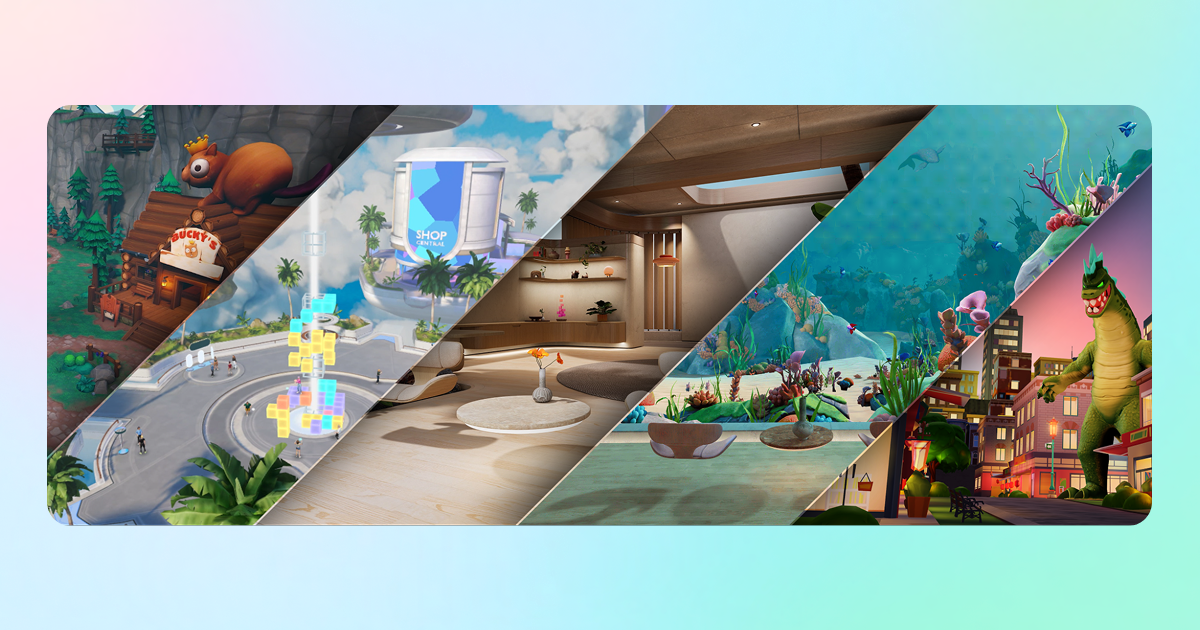
Meta's Horizon Engine imagery shows the kind of richer, faster-loading spaces Horizon Worlds needed much earlier. Source: Meta Horizon OS Developers.
That is why the Horizon Engine pivot was interesting. Meta described it as a new foundation for larger spaces, faster loading, more concurrent users, and delivery across Quest and phones. From what they showed, performance looked much better. Those were exactly the kinds of problems Horizon Worlds had been struggling with for years. But just as Meta seemed to be solving the engine-level issues, Horizon Worlds moved away from VR as the primary focus, at least for now. That is the painful part: the technology was finally becoming more appropriate for spatial worlds, while the product direction was becoming less centered on the headset experience where spatial worlds make the most sense.
Meta made that shift explicit in early 2026. In February, the company said Horizon Worlds would become "almost exclusively mobile", explicitly separating the Quest VR platform from Horizon Worlds and saying it was going all-in on mobile. Then, in March, Quest users were told that after June 15, 2026 they would no longer be able to build, publish, or update VR worlds. After backlash, Andrew Bosworth clarified that existing VR worlds would remain playable in a limited capacity, but new worlds would be mobile-only. Either way, the direction was clear: Horizon Worlds was no longer being treated as the VR-first social layer for Quest.
I understand why Meta would want Horizon Worlds on mobile. A social platform needs users, and VR headsets are still a small market. Mobile access can reduce friction, increase reach, and make it easier for people to join friends who already have headsets. But mobile also changes the competitive set completely. Horizon Worlds is no longer just competing with VRChat, Rec Room, or other headset-native social spaces. It is competing with Roblox, Fortnite Creative, Minecraft, TikTok, Discord, mobile games, and every other app fighting for a few minutes of attention on a phone.
That makes some of the reported mobile momentum hard to interpret. If Meta pushes the platform extremely hard, funds a lot of content, and pays creators based on engagement, growth can start to reflect the incentive structure as much as organic demand. Meta's own creator forum described a $50 million 2025 investment with bonuses for metrics including time spent on mobile, time spent on headset, retention, and in-world purchases, while explicitly saying mobile time was being rewarded more heavily. Incentives like that can produce activity, but they can also be prime for abuse if creators are rewarded for keeping users around rather than making genuinely good worlds.
In VR, Horizon at least had a reason to exist: shared spatial presence. On mobile, that reason becomes weaker. If the world is not visually impressive, not frictionless, not full of friends, and not obviously better than Roblox-like alternatives, why would people choose it? A mobile pivot may increase the addressable audience, but it does not automatically solve the product's identity problem.
What Is Meta's Future Play?
I do not think Meta has abandoned the metaverse idea in the deeper sense. I think the company has learned, painfully, that you cannot brute-force a full social computing platform into existence just by spending money and naming it loudly. The timing, hardware, standards, developer tools, and user habits all need to mature.
It is still so, so early. Building anything close to a real metaverse will take time. Headsets are still bulky, expensive, and not powerful enough to make this feel effortless. Agreeing on standards takes time. Getting different companies to cooperate on identity, payments, avatars, content formats, safety, and ownership takes even longer. It seems like Meta tried to push too hard too early, but that does not mean the metaverse cannot be built.
The more interesting question is whether Meta eventually tries to build something closer to a proper metaverse together with the rest of the industry. That would require accepting that no single company gets to own the entire layer. It would mean building on commonly accepted standards for 3D assets, identity, payments, avatars, networking, and application runtimes. It would mean treating interoperability not as a nice bonus, but as the point.
Will Meta actually do that? I am not sure. Meta has incentives in both directions. On one hand, an open metaverse could make Quest and future AR glasses more valuable, because more content would be available and developers would have more confidence investing in spatial experiences. On the other hand, Meta is still a platform company. Platform companies usually prefer owning the rails, the store, the social graph, and the economics.
My guess is that the future, if it arrives, will be messy and hybrid. Meta, Apple, Google, Microsoft, Epic, game engines, browser vendors, and standards bodies may all push pieces of the puzzle forward for their own reasons. Some parts will be open. Some parts will be locked down. Some standards will become boring and universal. Some ambitious virtual worlds will remain closed gardens forever.
That is why I still think the metaverse is a long game. Horizon Worlds was not the metaverse. It was not even a very good proto-metaverse. But the failure of one product, or one hype cycle, does not prove the idea is dead. It mostly proves that building a shared, interoperable, persistent spatial internet is much harder than making a headset demo or a corporate presentation.
The metaverse people imagined has not died. It has not been born yet.